George, Nicholas and Wilhelm: Three Royal Cousins and the Road to World War I by Miranda Carter
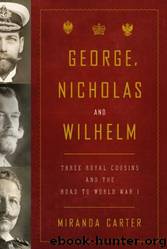
Author:Miranda Carter [Carter, Miranda]
Language: eng
Format: mobi, epub, azw3
Tags: 1901-1910, 1894-1917, Great Britain - History - Edward VII, Great Britain, Nicholas, Europe, Europe - Politics and government - 1871-1918, William, Royalty, Germany, World War I, 1914-1918 - Causes, Russia & the Former Soviet Union, 1914-1918, Historical, Military, World War, Russia, History, Germany - History - William II, General, 1888-1918, Edward, Biography & Autobiography, Russia - History - Nicholas II, Causes
ISBN: 9781400043637
Publisher: Random House of Canada
Published: 2010-03-23T05:33:22+00:00
For George, the new century had brought a few, though hardly momentous, changes. He’d taken up golf, cycling, bridge and the new sine qua non of royal luxury life, cars (Edward had a fleet of them by 1903)—all fashionable new pastimes. As the Prince of Wales, he acquired two further homes, Abergeldie, near Balmoral, and Frogmore, half a mile from Windsor Castle; he was made a trustee of the British Museum, in which he took no interest; and he was found a place on the Committee for Food in Wartime. Edward placed a desk next to his to ensure that his son had the experience of government that his mother had denied him. He was given a private secretary, Arthur Bigge, who had worked briefly for the queen, an effective, literate, organized, Conservative-voting ex-soldier, who told George not to look cross or bored in public. George quickly became as dependent on him as he was on May, and equally rude on occasion too. “I fear sometimes11 I have lost my temper with you and often been very rude, but I am sure you know me well enough by now to know that I did not mean it … I am a bad hand at saying what I feel, but I thank God that I have a friend like you, in whom I have the fullest confidence.”
What George’s new position did open him up to was the empire. After the queen’s death in 1901, he and May were sent to Australia to be present at the inauguration of the country’s first parliament and its transformation from six colonies into one “Commonwealth.” Edward had wanted to cancel the trip, but Balfour argued that he should go. The Boer War, which had exposed such hostility in Europe, had paradoxically turned Britain in on its empire, and made the government all the keener to emphasize the colonies’ bonds with the “Mother Country.” Balfour had come up with a new, more visible role for the monarchy in the empire. “The King is no longer merely King of Great Britain and Ireland and of a few dependencies whose whole value consisted in ministering to the wealth and security of Great Britain and Ireland,” he told Edward. “He is now the great constitutional bond uniting together in a single Empire communities of free men separated by half the circumference of the Globe.” Australia’s citizens knew “little and care little for British Ministries … But they know, and care for, the Empire … and for the Sovereign who rules it.”12 George’s visit, Balfour argued, was a great opportunity to make that connection real. But the war, together with the issue of Home Rule in Ireland and the growing independence movement in India, had also raised questions about whether the colonies actually wanted to be part of the empire. And grand though Balfour’s conception sounded, it was really another ornamental role, a job that required being rather than doing. George and May set off for eight months in March
Download
George, Nicholas and Wilhelm: Three Royal Cousins and the Road to World War I by Miranda Carter.epub
George, Nicholas and Wilhelm: Three Royal Cousins and the Road to World War I by Miranda Carter.azw3
This site does not store any files on its server. We only index and link to content provided by other sites. Please contact the content providers to delete copyright contents if any and email us, we'll remove relevant links or contents immediately.
| Military | Political |
| Presidents & Heads of State | Religious |
| Rich & Famous | Royalty |
| Social Activists |
Waking Up in Heaven: A True Story of Brokenness, Heaven, and Life Again by McVea Crystal & Tresniowski Alex(37815)
Empire of the Sikhs by Patwant Singh(23090)
We're Going to Need More Wine by Gabrielle Union(19055)
Hans Sturm: A Soldier's Odyssey on the Eastern Front by Gordon Williamson(18596)
Leonardo da Vinci by Walter Isaacson(13342)
The Radium Girls by Kate Moore(12036)
Tools of Titans by Timothy Ferriss(8403)
Educated by Tara Westover(8061)
How to Be a Bawse: A Guide to Conquering Life by Lilly Singh(7495)
Permanent Record by Edward Snowden(5852)
The Last Black Unicorn by Tiffany Haddish(5643)
The Rise and Fall of Senator Joe McCarthy by James Cross Giblin(5284)
Promise Me, Dad by Joe Biden(5157)
The Wind in My Hair by Masih Alinejad(5104)
A Higher Loyalty: Truth, Lies, and Leadership by James Comey(4967)
The Crown by Robert Lacey(4821)
The Iron Duke by The Iron Duke(4367)
Joan of Arc by Mary Gordon(4119)
Stalin by Stephen Kotkin(3973)
